
Post-Mortem: How My Web Game Hit 130k MAU with $0 Marketing (and Survived an AdSense Ban)
A transparent case study on indie game growth: from accidental multi-language localization to a successful B2B pivot in the US market, and scaling revenue after an AdSense restriction.
For the past few months, I’ve been fighting in the trenches of the indie game market. It has been a wild, stressful, and almost surreal ride. By the end of the 2025 holiday season, one of my projects hit a milestone of 100,000 Monthly Active Users (MAU). For a developer who has spent years in the "newbie" phase of the global market, this was incredible validation. But the story behind the numbers is far more chaotic than the charts suggest.
A Happy Accident: Scaling to 130k MAU
The initial success of this site was largely due to luck. While developing the game, I was using Claude Code. Due to some imprecise prompting on my part, Claude ended up generating a version of the site localized into five different languages.
The UI looked much better than I expected, and I didn't have the heart to roll back the code. So, I took a leap of faith and launched all five languages simultaneously. Usually, my habit was to launch in English first and indefinitely postpone other locales.
That "accidental" decision turned out to be the catalyst for our explosion. Within a month of launch, the Spanish version took off. We saw a massive influx of users from Spain, followed by a surge from Mexico and Latin America. By Christmas and New Year’s, the traffic peaked at 130,000 MAU. Looking back, if I hadn't unintentionally launched with multi-language support, this story wouldn't exist.
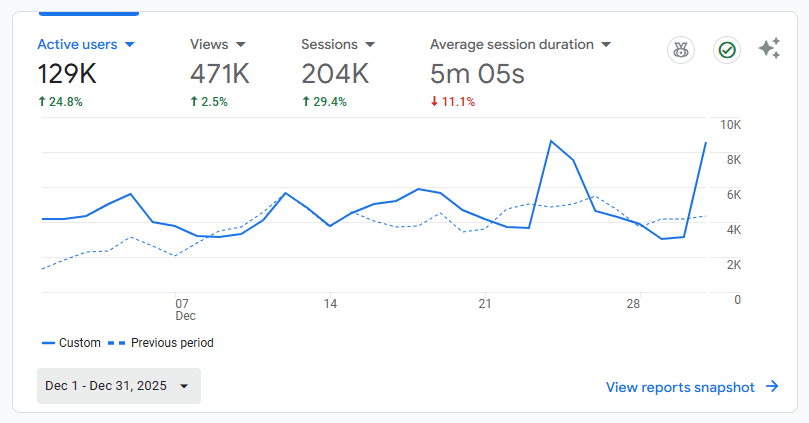
A surge in traffic peaking at over 130,000 MAU following multi-language launch.
The Great Pivot: From Spanish B2C to US B2B
After the holiday craze, the Spanish traffic began its natural decline, dropping to a low of about 80,000 MAU. However, I noticed something interesting: our US-based English traffic was starting to climb.
To capture this new momentum, I began adding more content and diving deep into SEO optimization. Through analysis with Gemini, I realized my multi-language implementation was riddled with bugs—specifically, my canonical tags were a disaster.
I spent several rounds of deep-diving with Gemini to "perform surgery" on the code, starting with the English homepage. I optimized the SEO metadata and copy step-by-step, while leaving the high-traffic Spanish pages untouched to avoid any sudden drops.
Unexpected Target Audience
As the Spanish traffic waned, I successfully migrated our core audience to the higher-value US market. The ad value (RPM) in the US is 5 to 10 times higher than in the Spanish-speaking regions. Traffic eventually stabilized back around 90,000 MAU, but with a surprising twist: the new users weren't just casual party-goers. They were teachers and HR professionals using the game for classroom education and corporate team-building events.
The AdSense Nightmare: When "Passive Income" Goes Flat
With high-value traffic stabilized, I naturally applied for Google AdSense. I thought I was on my way to consistent passive income. Instead of "making money while I sleep," AdSense almost made my business "sleep" permanently.
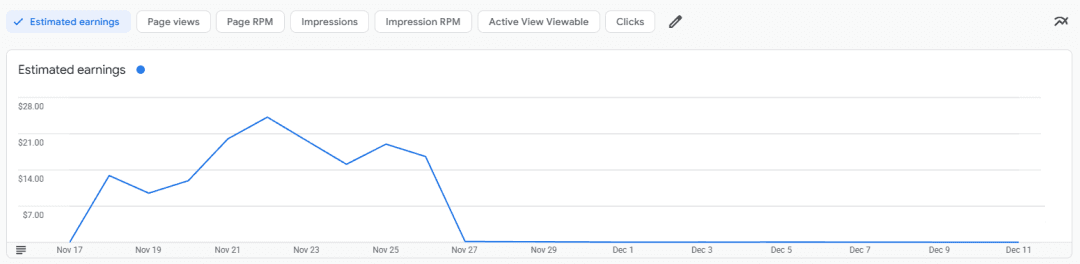
The moment passive income dreams were put on hold by AdSense restrictions.
Initially, shortly after successfully integrating AdSense, the site was hit with a restriction because the sheer volume of excited users led to rampant accidental clicks. After the account was restored, my daily CPC and revenue began to steadily recover, and the Click-Through Rate (CTR) was maintained at a very safe 2%.
But then, the "weekend effect" hit. Starting on a Friday, the CTR began to climb. It first approached 2.5% on Friday, and then by Saturday night (the first 6 hours of US time), it skyrocketed past 3%!
The reason? Friction. In a fast-paced browser game, users are anxious to start playing. When ads pop up and interrupt the flow, accidental clicks become inevitable. These "accidental clicks" are flagged by Google as Invalid Traffic.
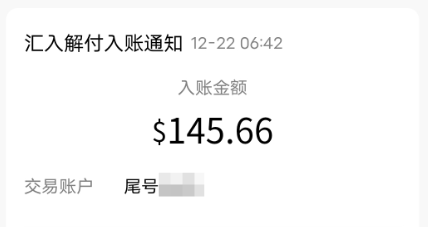
The first bittersweet payment of $145.66 received during the restriction period.
Despite my emergency efforts to reduce ad density and increase spacing, the AdSense penalty arrived. My account was restricted for the second time. Ironically, the very next morning—while my account was under restriction—I received a notification from my bank. My first-ever AdSense payment of $145.66 had arrived. It was my first taste of passive income from the global market, yet I felt no joy. Knowing my revenue had flatlined again left me in a state of constant anxiety.
The AI Intervention and the 80-Email Comeback
"In the depths of this frustration, I started questioning if the site was even worth keeping. I asked Gemini, "Based on my current traffic, what is the estimated valuation of this site if I were to sell it?""
Gemini: Gemini analyzed the data and gave me a surprisingly firm answer: "If I were you, I absolutely wouldn't sell right now." Instead, it recommended moving away from AdSense and looking for a gaming-specific ad platform.
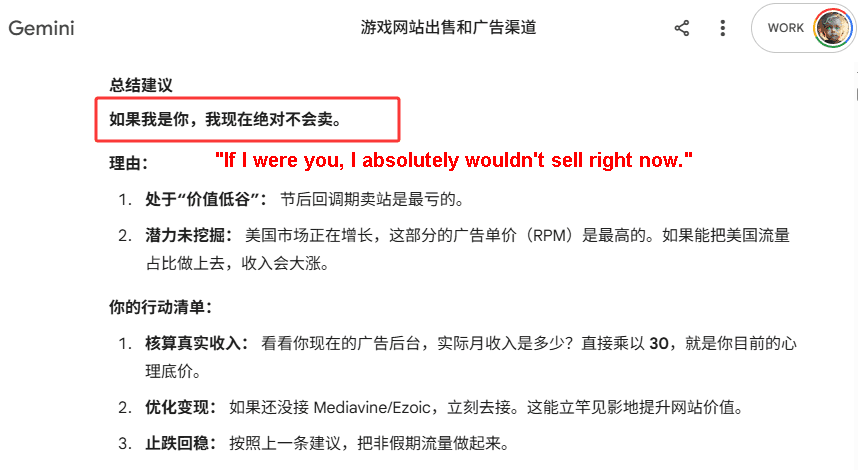
Gemini's game-changing advice to hold and pivot to specialized ad platforms.
That was the wake-up call I needed. I abandoned AdSense and reached out to Venatus, a premium ad network for the gaming industry. Over the next week, I exchanged nearly 80 emails with their account managers to get the integration right.
$1,279.55 Revenue
We got it live just before the Spring Festival. Since then, revenue has stabilized. Even as traffic naturally dipped to 50,000 MAU after the peak season, the site generated $1,279.55 over the last three months. As the Venatus "onboarding" period ends and eCPMs improve, there is significant room for growth.
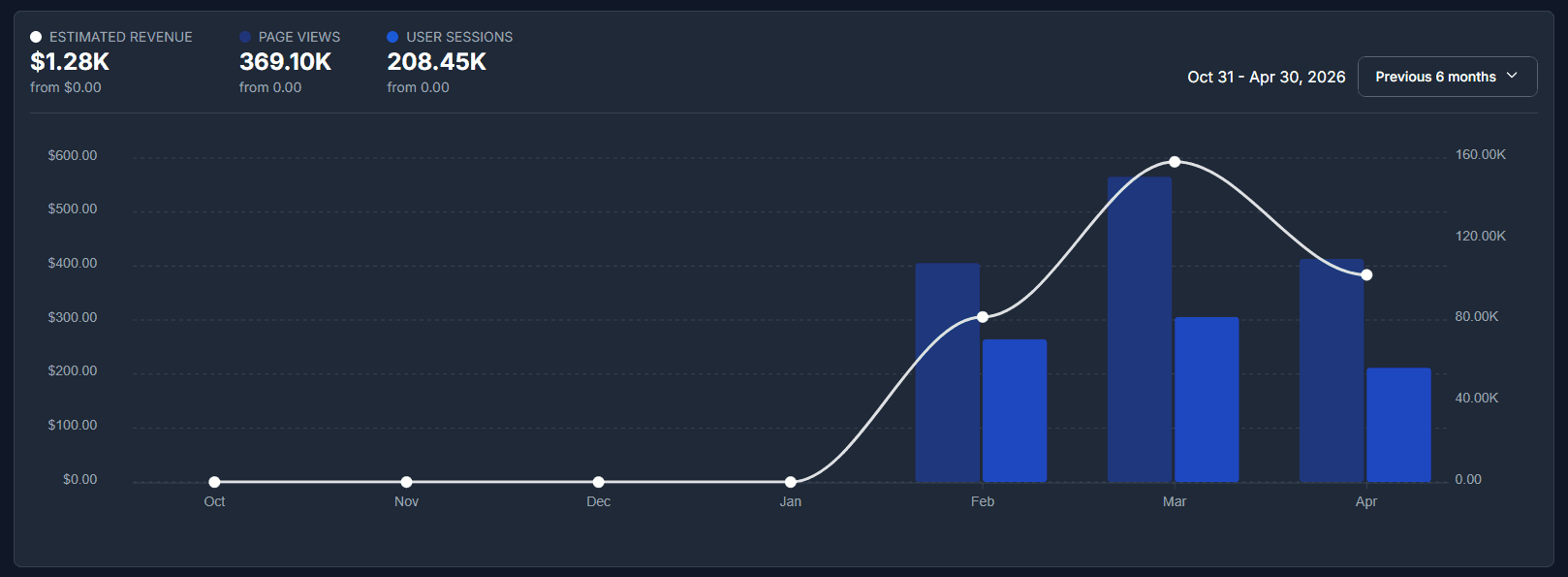
Revenue recovery and stability through the Venatus gaming ad network.
Long-termism: The Future of Web Games
Reflecting on this "roller-coaster" journey, I’ve realized that web-based games still have incredible vitality in today’s ecosystem.
Frictionless is a Superpower: The "no download, just play" nature of web games is a massive discoverability weapon. It allowed me to leverage SEO and accidental localization to reach 130k users with zero marketing spend.
Intent Matters More Than Volume: Raw traffic is great, but the intent of that traffic defines your ceiling. Moving from "pure entertainment" (Spanish casual users) to "utility/tool" (US educators and HR) is what gave the product long-term sustainability.
Built for Resilience: A monetization system must be built on a deep understanding of user behavior. Moving from the AdSense nightmare to a specialized partner like Venatus taught me that the urge to maximize short-term revenue must always be balanced against platform rules and user experience.
Today, ImposterGame covers its server costs and generates a healthy profit through ads and a small number of subscriptions. This is just the beginning. For indie devs, real success isn't just about going viral once—it’s about building a stable, compliant, and sustainable business loop in a volatile market.
I hope these lessons help other developers exploring non-traditional growth paths.
Want to play the game mentioned here?
Join thousands of players in the ultimate social deduction experience. No download required.